
Johns Creek: Why Georgia Red Clay Soil Matters for Concrete
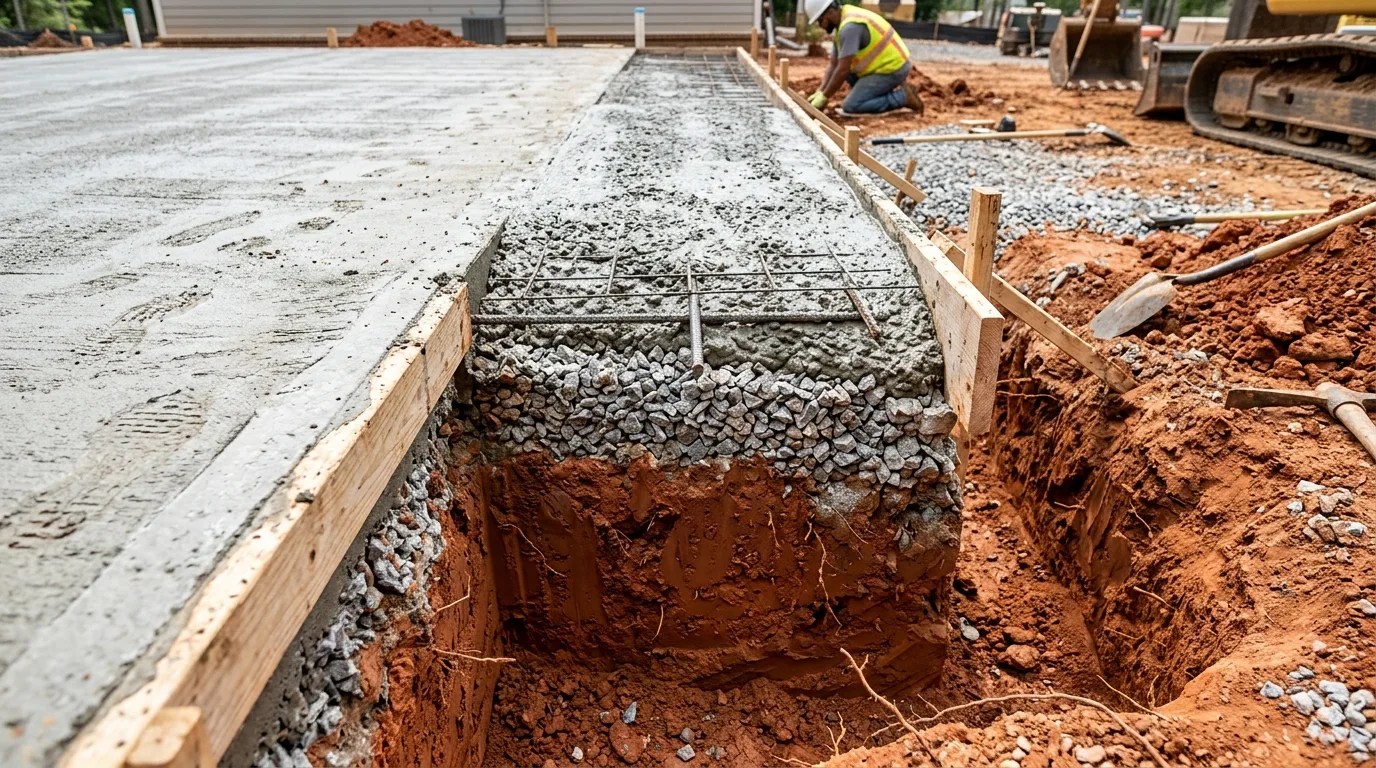
Johns Creek homeowners regularly call us about concrete driveways that cracked after five years, patios that heaved after a wet spring, and foundations showing diagonal stair-step cracks they never expected. In virtually every case, the culprit is the same: Georgia’s expansive red clay soil, which didn’t come with a warning label when the driveway was poured. Understanding how this soil works — and what it costs homeowners who build over it without proper preparation — helps you make better decisions before any concrete is placed.
In this post, we cover how Georgia red clay soil behaves, how that behavior damages concrete in Johns Creek specifically, what proper construction practice looks like, and when damage from clay movement has already occurred and requires repair.
Free Concrete Assessments for Johns Creek Homeowners
We evaluate existing concrete for clay soil damage and provide honest repair vs. replace recommendations.
Why Georgia Red Clay Behaves Differently Than Most Soils
Georgia red clay is technically classified as expansive clay — a soil with a high plasticity index that changes volume significantly with moisture content. When the clay dries, it shrinks and develops a network of cracks and voids. When it gets wet, it swells back toward its original volume — sometimes with considerable force. This expansion-contraction cycle isn’t a rare event in Fulton County; it happens every year, and in some years it happens multiple times as Johns Creek swings from spring rains to late summer droughts.
Soils in coastal markets like Florida or arid western markets don’t behave this way — sandy and loamy soils neither expand nor contract significantly with moisture changes. This is why construction guidance from national sources or contractors without Georgia-specific experience frequently underestimates the base preparation needed in Johns Creek. What works in Alpharetta’s slightly less clay-heavy soils or in Florida’s sandy soils simply isn’t adequate for the pure red clay that dominates the Medlock Bridge and Oxford Mill area.
How Clay Soil Damages Concrete in Johns Creek
The damage mechanism is straightforward. When clay beneath a concrete slab swells during Johns Creek’s wet spring season, it pushes upward with enough force to heave sections of the slab — this creates cracks and uneven edges that disrupt drainage and create trip hazards. When the clay later contracts in August and September’s dry heat, it pulls away from the slab base, creating voids. The slab now spans those voids without support, and vehicle loads or foot traffic can cause the unsupported section to crack or break through.
In older neighborhoods like Rivermont and The Falls of Autry Mill — where 1980s and 1990s construction sometimes used minimal base preparation — this cycle has been running for decades. The cumulative damage is exactly what you’d predict: widespread cracking, section settlement, heaving near edges and joints, and surface spalling from repeated freeze-thaw and moisture cycling on compromised slabs.
What Proper Construction Requires Over Clay
The engineering response to Georgia clay is well-established: replace the clay-contact zone beneath slabs with a non-expansive material before pouring. Standard practice for residential concrete in Johns Creek includes four to six inches of mechanically compacted gravel directly beneath the slab, which creates a stable, non-expansive interface between the clay and the concrete. The gravel doesn’t expand or contract with moisture, so the slab above it doesn’t experience the clay’s movement cycle.
Reinforcement is equally important. Rebar in a grid pattern at four-to-six-foot spacing, set at the midpoint of slab thickness, allows the concrete to redistribute loads and resist cracking when minor movement does occur below. Control joints cut every eight to ten feet direct any future cracking to planned locations. Together, these elements don’t eliminate clay soil movement — they manage its effect on the concrete above it.
Building on Georgia Clay? We Engineer for It.
Every Johns Creek project includes proper base preparation for Fulton County's expansive soil — documented in your written estimate.
Practical Uses for Understanding Clay Soil
- Evaluating contractor quotes: When you receive quotes that vary by $3–$5 per square foot, base preparation depth is often the difference. The lower quote may not include adequate compacted gravel over clay — ask specifically.
- Understanding existing damage: If your driveway has diagonal cracks or heaved sections near edges, clay soil movement is the most probable cause. Understanding this helps you evaluate whether repair or replacement is appropriate.
- Protecting new construction: If you’re building a new home in Doublegate or Sugar Mill, post-tensioned slab design is the current best practice for new residential construction on Georgia clay — it provides the most resistance to clay movement of any slab type.
- Foundation monitoring: Stair-step cracks in foundation walls, doors that stick seasonally (worse in summer dry, better after spring rains), and gaps above door frames that open and close are classic clay movement signatures in Johns Creek homes.
- Drainage design: Poor drainage around a foundation accelerates clay moisture variation — downspouts draining three feet from the house instead of six or more, landscaping sloped toward the structure, and hardscaping that prevents rainfall dispersion all worsen clay movement.
- Retaining wall design: Georgia clay generates significant lateral soil pressure when saturated — retaining walls in Johns Creek require drainage behind them that most other markets don’t demand.
When Damage Has Already Occurred
If your concrete is already showing clay movement damage, the repair approach depends on whether the movement is ongoing or has stabilized. Repairing a crack or resurfacing a slab over active clay movement — without correcting the drainage conditions that are perpetuating the moisture variation — produces repairs that fail within one to three years.
For most Johns Creek properties, stabilizing clay movement means correcting drainage first: extending downspouts, regrading if necessary, and addressing any landscape features that concentrate moisture near the structure. Once drainage is corrected and the soil moisture cycle moderates, structural or surface repairs to the concrete have a reasonable chance of holding.
In severe cases where the clay movement has created voids under a slab, mudjacking — pumping stabilizing grout beneath the slab to fill voids and lift settled sections — is the appropriate intervention before surface repair. Our concrete repair service and foundation repair service both incorporate this assessment as standard.
Frequently Asked Questions
Is Georgia red clay the same everywhere in the Johns Creek area?
Clay content varies across Fulton County and adjacent Forsyth County. The densest, most expansive clay is typically found in the older geologic formations in central and southern Johns Creek. Properties closer to the Chattahoochee River corridor may have slightly more varied soil profiles with some alluvial deposits. Regardless of location within Johns Creek, base preparation for clay soil is standard practice — the consequences of omitting it are too predictable to justify the cost savings.
Can post-tensioned slabs prevent clay soil cracking entirely?
Post-tensioned slab design dramatically reduces clay soil cracking compared to conventional reinforced slabs. The internal cable tension keeps the concrete in compression and resists the bending and cracking that clay movement would otherwise produce. It’s now standard in new residential construction in most of Georgia. For existing driveways and patios on conventional reinforced slabs, proper base preparation and control joints are the available tools for managing clay effects.
How much does fixing clay soil damage typically cost?
Minor crack repair from clay movement runs $500–$2,000 for most residential driveways. Mudjacking to fill voids and re-level sections runs $500–$1,500 per treatment zone. Full driveway replacement when clay damage has accumulated to the point where repair is no longer cost-effective runs $6,000–$12,000 depending on size and finish. See our concrete driveway cost guide for full pricing context.
Concrete Built for Georgia Clay in Johns Creek
Call Johns Creek Concrete Contractors at (888) 376-0955 for a free assessment of your concrete or foundation.
Related: