
Johns Creek Foundation Repair: What Homeowners Should Know
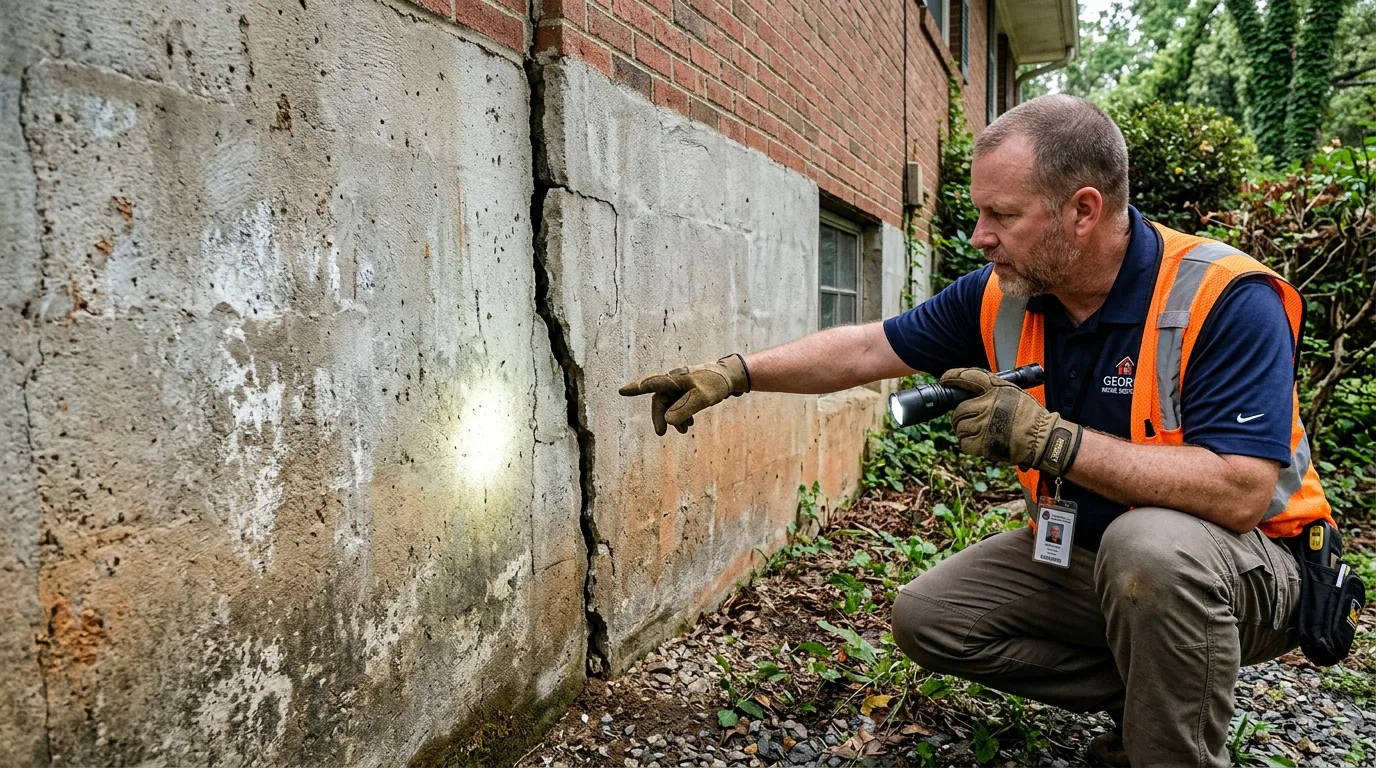
For a Johns Creek homeowner in Rivermont or St. Ives who first notices a diagonal crack above a doorframe, the range of possible explanations spans from “cosmetic settling” to “significant foundation movement.” The honest answer is that you can’t tell from the crack alone — you need a qualified assessment that looks at the pattern of movement, the drainage conditions, and whether the movement is ongoing. What we can tell you is that in Fulton County, the most probable cause of the crack is Georgia’s expansive red clay soil, and understanding how that soil works helps you evaluate whatever you’re told.
In this post, we cover the causes of foundation movement in Johns Creek, warning signs to monitor, what repair approaches address which problems, and what realistic costs look like for the Fulton County market.
Free Foundation Assessments for Johns Creek Homeowners
We evaluate foundation conditions honestly — drainage, soil, and structural factors together.
What Causes Foundation Movement in Johns Creek
Georgia’s red clay is classified as expansive soil because it changes volume significantly with moisture content. In Fulton County, this soil is the primary driver of residential foundation problems. The cycle is predictable: winter and spring rains saturate the clay, causing it to expand and push upward or outward against foundation walls. Late summer drought contracts the clay, pulling away from walls and slabs and creating voids that allow settlement. Over 20–30 years, this cycle produces measurable foundation movement in homes built without adequate drainage controls.
Secondary causes include inadequate downspout extension (the standard four-foot extension leaves water within soil range of the foundation), landscaping that slopes toward the house, and hardscaping that concentrates rainfall runoff against the foundation perimeter. In neighborhoods like The Falls of Autry Mill and Oxford Mill — where extensive hardscaping and mature landscaping characterize many properties — these secondary drainage issues compound the clay soil’s baseline behavior and accelerate movement.
Warning Signs to Watch For
Stair-step cracking in brick or block: Diagonal cracks that follow the mortar joints in a stair-step pattern indicate differential settlement — sections of the foundation moving at different rates. This is a direct clay soil movement signature.
Diagonal cracks at door and window corners: Cracks running at 45 degrees from the corners of openings indicate frame distortion from foundation movement. Single small cracks can be cosmetic; multiple cracks at multiple openings indicate systematic movement.
Doors or windows that stick seasonally: If doors stick in summer (when clay is wet and swollen) and work fine in winter, the foundation is moving with the clay’s moisture cycle. This is an active, ongoing condition.
Horizontal cracks in basement or crawlspace walls: Horizontal cracking in a basement or crawlspace wall is a serious sign of lateral soil pressure — the soil outside is pushing in. This requires prompt professional evaluation.
Floors that slope or feel uneven: Floor slope that wasn’t present when the home was new, particularly if it worsens over time, indicates ongoing foundation settlement beneath that area.
Gaps opening at the top of walls or between the ceiling and partition walls: Settlement pulling the structure downward can open gaps in areas that move but aren’t directly cracked.
Types of Foundation Repair
Crack injection: For minor foundation cracks without structural movement, polyurethane or epoxy injection waterproofs the crack and prevents further water infiltration. This is a waterproofing measure rather than a structural repair — appropriate when the crack is not widening and movement has stabilized.
Carbon fiber wall reinforcement: For basement or crawlspace walls showing lateral movement (horizontal cracking or bowing), carbon fiber straps bonded to the wall face resist further movement. This is structural reinforcement rather than repair of existing damage — appropriate for walls in early stages of lateral movement.
Helical or steel push piers: For foundation settlement — sections of the foundation that have dropped — pier underpinning lifts the settled section and supports it on deeper, more stable soil or bedrock. This is the most common structural repair for Georgia clay settlement and the most impactful in terms of cost.
Drainage correction: For homes where inadequate drainage is perpetuating clay moisture variation, correcting drainage often prevents further movement more effectively than structural repairs alone. French drains, extended downspouts, and grading corrections address the moisture source. Without drainage correction, structural repairs have to absorb ongoing soil pressure rather than operating in a stabilized environment.
Foundation Assessment Includes Drainage Evaluation in Johns Creek
We don't just look at the cracks — we evaluate the water management conditions driving them. Call (888) 376-0955.
Practical Uses for Foundation Knowledge
- Monitoring existing cracks: Document cracks with photographs and measure width. If the same crack has grown from 1/8 inch to 3/16 inch over 12 months, the movement is active and requires professional evaluation. Stable cracks don’t require immediate structural intervention.
- Pre-purchase inspections: In Duluth and Alpharetta communities near Johns Creek, foundation condition is one of the highest-stakes items in a home inspection. Understanding what you’re seeing helps you evaluate the inspector’s report.
- Drainage improvement before repairs: If you’re planning foundation repairs, addressing drainage first often reduces the structural scope needed — and always improves long-term repair durability.
- Selling with known foundation issues: Disclosed foundation repairs with documentation of professional work and permits typically affect sale price less than undisclosed issues discovered during inspection. Having a paper trail of what was done and why is valuable.
- New construction considerations: Post-tensioned slab design and proper perimeter drainage are the best protections for new construction on Georgia clay. If building or adding in Johns Creek, verify these are included in the construction documents.
- HOA requirements for repair work: Structural repairs visible from the exterior in communities like Rivermont may require HOA notification or approval before work begins.
What Foundation Repair Costs in Johns Creek
Foundation repair cost in Johns Creek is highly variable because it depends on damage type, extent, and whether drainage correction is needed. For planning purposes:
Minor crack injection: $500–$1,500 for typical residential foundation crack treatment. Drainage correction (French drain, downspout extension, regrading): $1,500–$5,000 depending on scope. Carbon fiber wall reinforcement for one 8-foot wall section: $1,500–$3,500. Helical pier underpinning: $1,000–$3,000 per pier, with most residential projects requiring four to eight piers. Comprehensive foundation repairs including drainage, piers, and crack treatment: $10,000–$25,000 in complex cases.
Early intervention dramatically reduces total cost. The same movement addressed at a minor crack stage costs 20–30% of the cost when addressed after secondary damage has accumulated through the structure.
Frequently Asked Questions
Is foundation cracking normal in Georgia homes?
Minor hairline cracking in foundation walls is common in Georgia homes on clay soil — the seasonal movement produces cosmetic cracking in many homes without structural significance. The key assessment factors are crack pattern (diagonal indicates differential movement), crack width (over 1/4 inch warrants evaluation), whether the crack is growing (take dated photographs), and whether you’re seeing other movement signs like sticking doors or floor slopes. A professional evaluation is warranted when cracks are growing or accompanied by other movement indicators.
Can I tell if my foundation problem is serious without a contractor?
You can identify red flags — growing cracks, multiple signs of movement, horizontal wall cracking — but accurately assessing the cause, the severity, and the appropriate repair requires professional evaluation. The most important thing homeowners can do independently is document crack dimensions with photographs over time, which gives a contractor objective data about whether movement is active.
How does foundation repair affect home insurance and resale?
Documented, professionally repaired foundation work with permits has minimal negative impact on resale in most cases — buyers and their inspectors understand that Georgia clay homes require occasional maintenance. Undisclosed foundation issues discovered in inspection have significantly more negative impact. Our foundation repair service includes documentation suitable for disclosure and insurance purposes.
Foundation Repair for Johns Creek Homes on Georgia Clay
Call Johns Creek Concrete Contractors at (888) 376-0955 for an honest foundation assessment.
Related: