
Stamped Concrete vs. Pavers: Best for Johns Creek Homes?
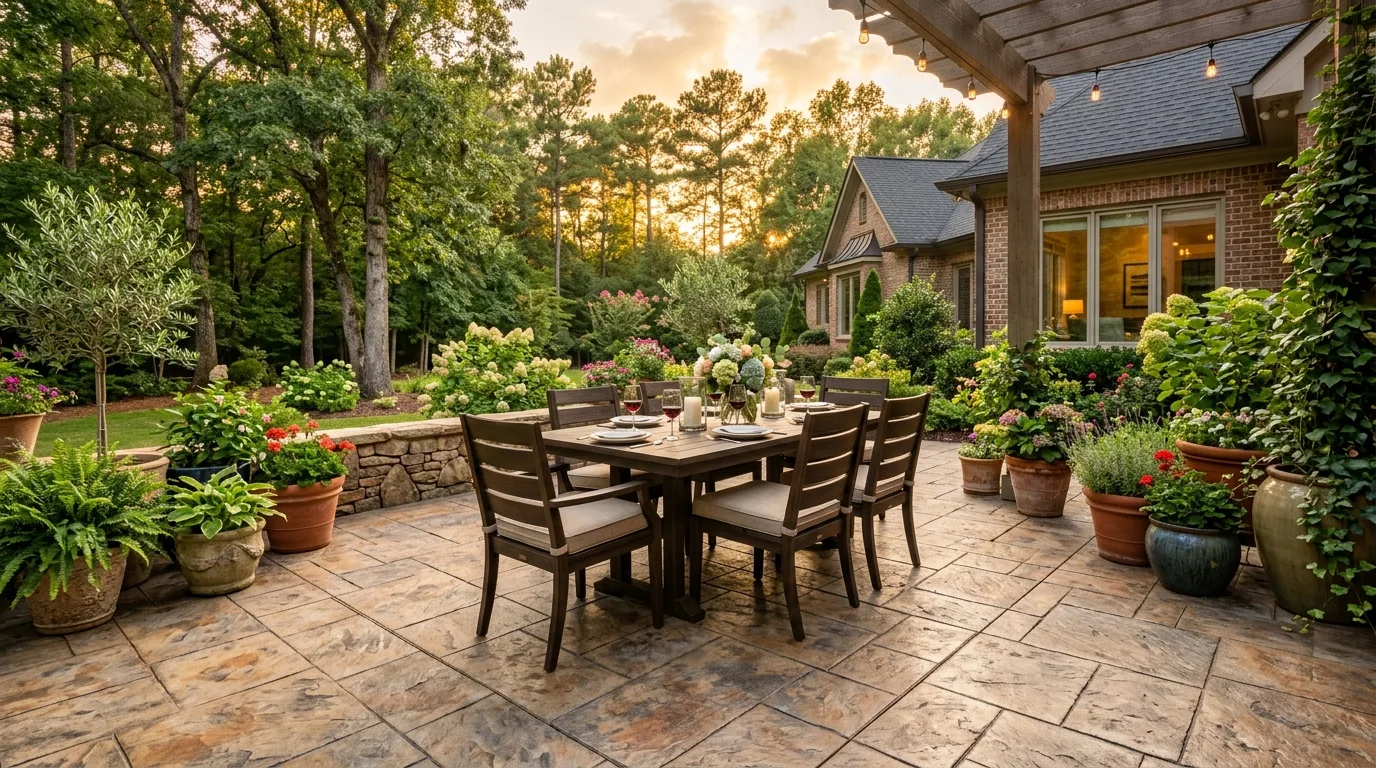
The patio showroom looks like an easy decision — pavers seem more premium, stamped concrete seems more economical — but the showroom doesn’t have Georgia red clay beneath it. In Johns Creek’s Fulton County soil conditions, the choice between stamped concrete and pavers has a practical dimension that transcends aesthetics: which material performs better on clay soil that swells and contracts with every rain cycle?
In this post, we cover cost comparison, durability differences in Georgia’s climate, maintenance requirements, and which option makes more sense for different Johns Creek homeowners based on their priorities.
Get a Free Quote for Stamped Concrete in Johns Creek
We install stamped concrete patios, driveways, and walkways throughout Johns Creek and North Metro Atlanta.
Why Georgia Red Clay Changes the Pavers Equation
The case for pavers is typically their ability to flex — individual units can be reset if they shift, while a cracked concrete slab requires more significant repair. That flexibility argument makes sense on stable soils. On Fulton County’s expansive red clay, it cuts differently.
Georgia red clay swells when wet and contracts when dry, creating a surface in constant motion during rainfall cycles. Individual pavers set on clay tend to shift independently — not uniformly — creating an uneven surface with raised edges that are both a tripping hazard and an aesthetic problem. In the Medlock Bridge and Oxford Mill neighborhoods, homeowners who chose pavers over stamped concrete in the late 2000s are frequently dealing with resetting costs that have accumulated to near the original installation cost.
Stamped concrete on adequately prepared gravel base behaves as a monolithic slab that distributes the clay movement across its full area and uses control joints to channel any cracking to planned locations. On clay soil, this is a significant structural advantage — the whole slab moves together rather than individual pieces ratcheting against each other.
Types and Options for Both Materials
Stamped concrete options:
- Ashlar slate or random stone patterns — the most popular in St. Ives and Rivermont for their natural stone appearance at concrete cost. Runs $12–$18/sq ft installed.
- Cobblestone or brick patterns — complement traditional architecture in Doublegate and Sugar Mill communities. Similar price range.
- Wood plank patterns — increasingly popular for pool decks where a natural look is desired without the splinter risk of real wood.
- Custom multi-color antiquing — adds $2–$4/sq ft for the color contrast that makes patterns appear more like natural materials.
Paver options:
- Concrete pavers — cast concrete units in various sizes. Most economical paver option, $12–$18/sq ft installed.
- Natural stone pavers (travertine, flagstone) — higher end, $18–$35/sq ft. Common in St. Ives golf community properties.
- Brick pavers — traditional look that suits Johns Creek’s classic Georgian architecture. $15–$25/sq ft installed.
- Permeable pavers — allow water infiltration, relevant for properties near Autrey Mill Nature Preserve where stormwater management matters. Premium over standard pavers.
Practical Uses for Each Option
- Large patio slabs: Stamped concrete outperforms pavers on large areas because unit cost decreases with scale and the monolithic surface handles Georgia clay movement better than thousands of individual pieces.
- Pool decks: Stamped concrete provides consistent slip-resistance, handles chemical exposure better than most pavers, and gives designers more pattern flexibility around pool shapes.
- Driveways: Stamped concrete strongly outperforms pavers for driveway applications — vehicle loads concentrate on individual pavers and cause edge chipping and rocking that stamped concrete avoids.
- Small accent areas: Pavers can make sense for small decorative areas where flexibility of design and the ability to remove individual pieces for utilities access is valued.
- Front walkways: Either can work beautifully — stamped concrete for a seamless look matching the driveway, pavers for a more traditional segmental feel. Both require proper base prep on clay soil.
- Areas near tree roots: Where roots may shift over time, the ability to reset individual pavers without breaking out a slab has practical value — one case where pavers may genuinely outperform.
How Georgia’s Climate Affects Long-Term Performance
Maintenance diverges significantly over time in Georgia’s climate. Stamped concrete requires resealing every two to three years to maintain color vibrancy and surface protection — in Johns Creek’s hot summers with average July highs of 89°F and intense UV, this interval shortens for south-facing surfaces to 18–24 months. The resealing cost is typically $0.50–$1.50/sq ft — manageable for a 400-square-foot patio.
Pavers require periodic resanding of joints (polymeric sand, not regular sand, to prevent weed growth and ant disruption), periodic resetting of shifted units, and sealing if they’re sealed at all. In Fulton County’s clay soil, resetting frequency for pavers is higher than in sandy or loam soils — many Johns Creek homeowners reset a section every three to five years. The cumulative resetting cost over a paver installation’s lifetime can approach or exceed the initial cost advantage over stamped concrete.
Compare Stamped Concrete and Paver Options for Your Johns Creek Project
We can quote both options so you can evaluate the actual cost and performance difference for your specific site.
Cost Comparison Summary
For a 400-square-foot patio, stamped concrete with integral color and standard sealer in Johns Creek runs $7,000–$11,000 installed. Concrete pavers run $5,500–$8,000 for basic options and $8,000–$14,000 for natural stone. The cost advantage of basic pavers over stamped concrete is narrower than most homeowners expect, especially when base preparation is priced correctly for clay soil in both cases.
Over a 20-year lifecycle, stamped concrete with regular resealing typically costs less total than pavers with periodic resetting on Georgia’s clay — particularly for large areas or driveways.
Frequently Asked Questions
Which holds up better in Georgia’s hot summers?
Both materials handle heat, but stamped concrete has a slight advantage from UV resistance in the sealer. Direct sun causes paver joint sands to degrade faster and some paver colors to fade — especially lower-cost concrete pavers with pigmented coatings rather than through-body color. For a south-facing Johns Creek patio with full summer sun exposure, quality sealed stamped concrete typically maintains appearance better with less intervention.
Can pavers be installed over existing concrete in Johns Creek?
Yes, but this approach is not recommended on Fulton County’s clay soil. Installing pavers over an existing slab doesn’t address the underlying base movement that caused the original slab to crack. If the concrete slab is failing, the movement will continue and affect the pavers above it within a few years. See our concrete patio cost guide for full replacement considerations.
Which option adds more resale value in Johns Creek?
In Johns Creek’s market, stamped concrete patios in good condition are perceived as premium improvements by buyers. Quality natural stone pavers (travertine, bluestone) can command a slight premium over stamped concrete for smaller accent areas — but for large patios and driveways, the stamped concrete market perception is comparable. Both materials substantially outperform plain concrete for perceived value in the Fulton County market.
Free Quotes for Stamped Concrete Patios in Johns Creek
We install decorative concrete throughout Johns Creek, Alpharetta, Roswell, and Suwanee.
Related: