
Retaining Walls for Johns Creek Sloped Yards: Solutions
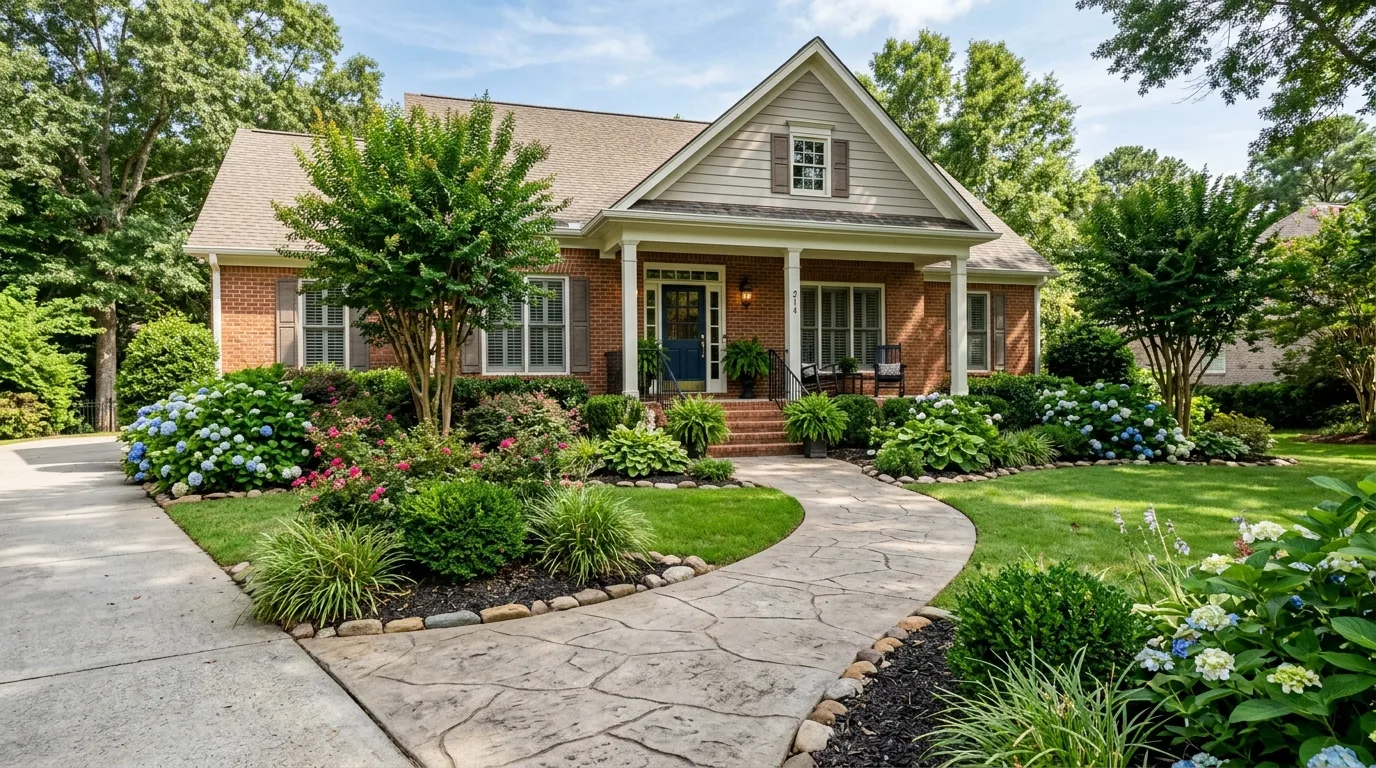
Johns Creek’s wooded, hilly terrain is part of what makes it appealing — the rolling topography near Autrey Mill Nature Preserve and along the Chattahoochee River corridor creates the elevated lots, wooded backdrops, and natural character that distinguish the community from flatter suburban developments. It also creates slopes that, without active management, erode after every Georgia thunderstorm and gradually undermine landscaping, hardscaping, and in some cases the home’s foundation itself.
A well-designed concrete retaining wall in Johns Creek doesn’t just hold soil back — it redirects water, creates usable level space, and manages the same clay soil dynamics that affect every other concrete structure in Fulton County. In this post, we cover what makes retaining walls work in Georgia’s conditions, what options fit different slope scenarios, and what homeowners should know about permits and costs before starting a retaining wall project.
Free Retaining Wall Estimates for Johns Creek Properties
We design drainage-inclusive retaining walls for Fulton County's clay soil and seasonal rainfall. Call (888) 376-0955.
Why Drainage Design Defines Retaining Wall Performance in Johns Creek
The single most common retaining wall failure in Fulton County isn’t a structural failure — it’s a drainage failure. A wall that was perfectly sized for the lateral soil load it was designed to hold fails when that soil becomes saturated with Georgia’s spring rainfall and the load triples. Saturated Georgia clay exerts roughly three times the lateral pressure of dry clay — a pressure increase that walls without drainage behind them weren’t designed to handle over the long term.
The drainage solution is three components working together: a gravel backfill zone (typically one to two feet wide) behind the wall that prevents clay from contacting the wall face directly; a perforated drain pipe at the footing level within the gravel zone that conveys collected water to daylight; and weep holes at regular intervals at the base of solid walls (poured concrete and mortared block) that provide overflow relief when the drain pipe’s capacity is exceeded. These elements add to initial construction cost but are the difference between a wall that lasts forty years and one that tilts outward in fifteen.
Types of Retaining Wall Options for Johns Creek Slopes
Poured concrete walls: The highest-strength option for tall walls (four feet and above) and walls carrying significant surcharge loads (driveways, structures above the wall). Requires formed construction and rebar reinforcement. The wall face can be textured, stamped, or veneered with stone for aesthetic integration. Best for applications where structural performance is the primary criterion. Cost: $100–$200+ per linear foot depending on height and drainage requirements.
Concrete block (CMU) walls: Concrete masonry unit construction allows more flexible design layouts than poured walls and can be finished with stucco or stone veneer. Structural grade with filled cores and rebar reinforcement is required for walls over 24 inches tall. Common in Oxford Mill and Doublegate for their combination of strength and design flexibility. Cost: $75–$150 per linear foot.
Segmental retaining wall systems: Engineered interlocking concrete block systems (Allan Block, Versa-Lok, and similar) are popular for residential applications in The Falls of Autry Mill and Medlock Bridge because they provide a natural stone appearance without the cost of true stone or veneered poured concrete. They’re gravity walls — not reinforced — and are appropriate for walls up to three to four feet without geogrid reinforcement. Taller applications require geogrid layers extending into the backfill for stability. Cost: $50–$100 per linear foot for standard applications.
Practical Uses for Retaining Walls
- Erosion control on sloped lots: A wall at the base of a slope catches and redirects runoff that would otherwise strip topsoil from the entire hillside. Johns Creek’s clay-heavy soils erode significantly during heavy thunderstorms without management.
- Creating usable flat areas: Terracing a sloped backyard into two or three levels with retaining walls at each transition creates flat zones for patios, play areas, and gardens on lots where the natural grade would prevent outdoor use.
- Protecting foundation from slope drainage: A wall intercepting water that would otherwise flow toward the house foundation redirects it laterally and away — one of the most effective foundation protection measures for sloped lots.
- Driveway approaches on hilly lots: When a driveway crosses a grade change, retaining walls on either side of the cut hold back the hillside and allow a stable, compacted driveway base.
- Pool deck level transitions: Terraced pool deck areas using retaining walls at transitions are common in St. Ives and Rivermont properties where natural grade changes create multi-level outdoor living spaces.
- Replacing failed walls: Many neighborhoods developed in the 1980s and 1990s have original retaining walls — often undrained landscape timber or unmortared block — that have reached the end of serviceable life. Replacement with properly drained concrete provides superior performance and lifespan.
Permit Requirements for Retaining Walls in Johns Creek
The City of Johns Creek has two permit categories for retaining walls. Walls 48 inches (four feet) and taller require a full building permit with structural documentation — typically a structural engineer’s stamp on wall design drawings. Walls under 48 inches require a Minor Land Disturbance permit.
Both permit types require compliance with Georgia State Minimum Standard Codes and applicable Fulton County requirements. Property line setbacks must be evaluated during permit review — walls cannot typically be built at the property line without specific authorization. HOA approval in communities like Rivermont and Medlock Bridge is required for visible exterior structures and must be obtained before City permit submission in most cases.
Retaining Wall Permits and Construction in Johns Creek
We handle all permits and HOA coordination for retaining wall projects throughout Fulton County.
What Retaining Walls Cost in Johns Creek
Concrete and concrete block retaining walls in Johns Creek typically cost $50–$200 per linear foot depending on wall type, height, and drainage requirements. A 50-foot wall at 3.5 feet height in segmental retaining block with proper drainage runs $4,000–$7,000. The same wall in poured concrete runs $6,000–$10,000. Height significantly affects cost — walls over 48 inches require deeper footings, more drainage infrastructure, and structural documentation that adds cost at every height increment.
Decorative treatments — stone veneer, stamped concrete face, or premium block systems — add $15–$40 per square foot of exposed face area. In St. Ives and The Falls of Autry Mill, decorative finishes are common because the wall is visible from the main outdoor living areas and contributes to the overall hardscape aesthetic.
Frequently Asked Questions
How high can a retaining wall be without an engineer in Johns Creek?
All walls require some form of permit in Johns Creek — walls under 48 inches need a Minor Land Disturbance permit, and walls 48 inches and taller need a building permit with structural documentation. For building permits, structural engineer-stamped drawings are typically required. There’s no height at which a retaining wall in Johns Creek is truly permit-exempt — the Minor Land Disturbance threshold is the lower tier, not an exemption.
What’s the difference between a landscape wall and a structural retaining wall?
For permit purposes in Johns Creek, height is the primary distinction — 48 inches is the threshold between the two permit categories. For design purposes, a structural retaining wall is any wall that holds back significant soil mass, carries surcharge loads from driveways or structures above, or is tall enough that failure would create a hazard. Landscape walls in the four-to-eighteen-inch range are decorative and gravity-only — no drainage or reinforcement required. As soon as a wall needs to hold back soil mass against Georgia’s clay soil pressure and rainfall, it should be treated as structural.
Can I install a retaining wall myself in Johns Creek?
Homeowners can pull their own permits for work on their primary residence, and some simple landscape walls can be owner-installed. However, for walls over 24 inches holding back significant soil, improper drainage design is the most common DIY failure mode — and in Georgia’s clay conditions, a drainage-free wall that fails can cause significant soil movement, damage to adjacent hardscaping, and potential foundation impact. The permit process exists partly to ensure adequate drainage design gets into the project scope.
Drainage-Engineered Retaining Walls for Johns Creek
Call Johns Creek Concrete Contractors at (888) 376-0955 for a free estimate on your retaining wall project.
Related: