
Commercial Concrete Contractors in Johns Creek: What Businesses Need
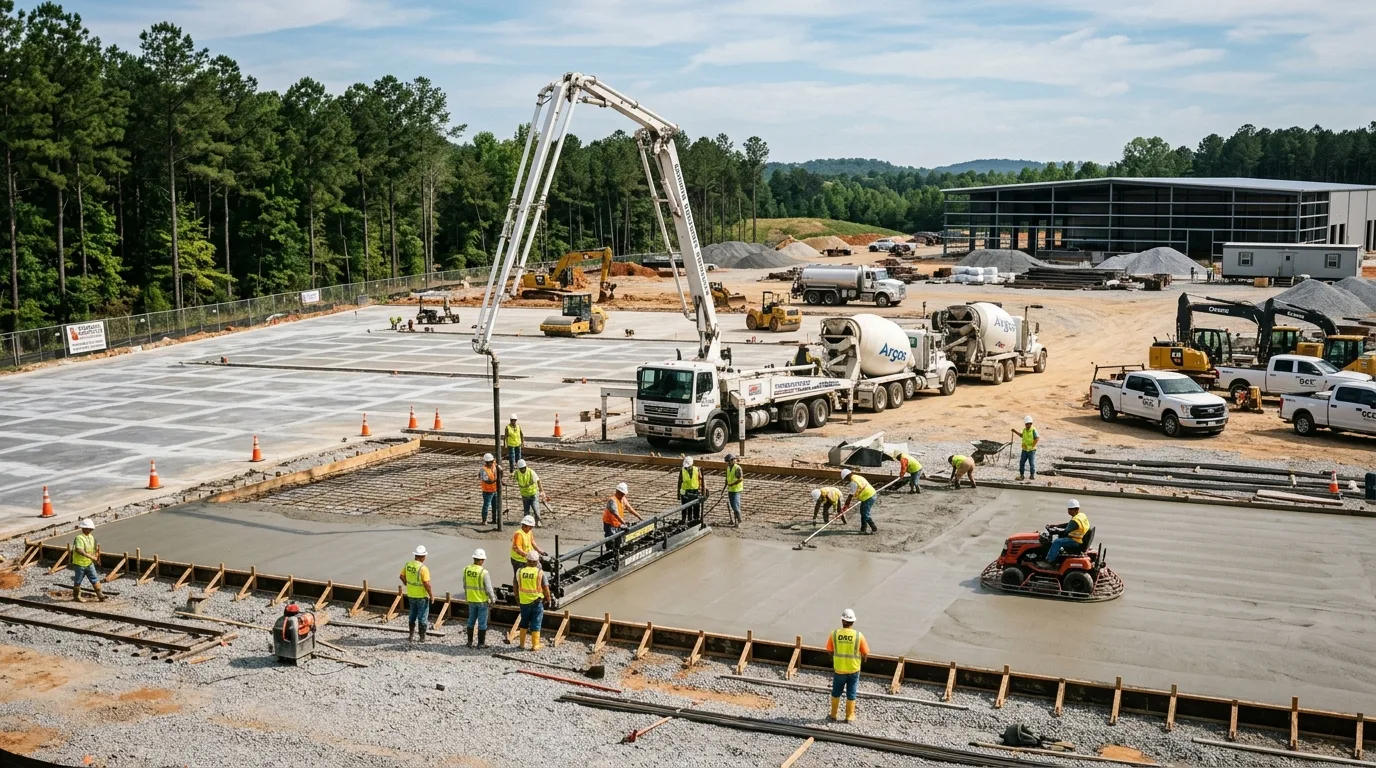
Commercial concrete in Johns Creek has specific requirements that residential work doesn’t — higher load ratings for vehicle traffic, drainage compliance for commercial impervious surface rules, and permitting processes that differ from residential. For businesses on Technology Parkway, State Bridge Road, or the commercial corridors along State Route 141, understanding what commercial concrete work involves in Fulton County helps you evaluate contractors and project timelines accurately.
In this post, we cover the types of commercial concrete work most common in Johns Creek, what specifications differ from residential, how the permit process works for commercial projects, and realistic cost ranges for the Fulton County market.
Commercial Concrete Estimates for Johns Creek Businesses
We handle commercial parking lots, slabs, and flatwork throughout Johns Creek and North Metro Atlanta.
How Commercial Concrete Differs From Residential
The fundamental difference between commercial and residential concrete in Johns Creek is load specification. A residential driveway is designed for passenger vehicles — typically six to eight thousand pounds, distributed across four wheels. A commercial parking lot handles delivery trucks, service vehicles, and potentially tractor-trailer access — loads that can reach 80,000 pounds concentrated on axle groups. The concrete must be significantly thicker (six to eight inches instead of four inches), reinforced with rebar rather than wire mesh in most cases, and poured at higher PSI specifications (4,000 PSI or higher versus 3,000 PSI for residential work).
The other significant difference is drainage compliance. Commercial impervious surface in Johns Creek falls under the City’s stormwater management requirements, and new or significantly expanded commercial paving may trigger stormwater management plan requirements. A contractor who handles only residential work may be unfamiliar with these requirements — choosing a contractor with specific commercial experience in Fulton County avoids permit complications from inadequate stormwater documentation.
Common Commercial Concrete Applications in Johns Creek
Parking lots and parking areas: The highest-volume commercial concrete application in Johns Creek’s retail and office parks. Design considerations include load zones (different thickness for drive lanes vs. parking stalls), drainage slope (minimum 2% toward collection points), concrete joint design for thermal expansion management, and ADA-compliant accessibility paths and parking spaces.
Loading dock areas and aprons: Concrete at loading dock areas handles concentrated vehicle loads from delivery trucks and forklifts — among the highest loads concrete flatwork experiences. Typical specification is seven to eight-inch thickness with #4 rebar at 18-inch spacing and 4,000 PSI concrete. Proper drainage design at dock areas is critical to prevent water infiltration that degrades the clay sub-base over time in Johns Creek’s conditions.
Warehouse and industrial floor slabs: For warehouse-to-shell development or tenant improvements requiring new floor slabs, specification depends on anticipated use (foot traffic vs. forklift vs. rack storage). Industrial floor slabs in Johns Creek typically require six to eight-inch thickness, 4,000 PSI concrete, and either post-tensioning or conventional rebar reinforcement depending on span and sub-grade conditions.
Concrete curbs and wheel stops: Curbs defining parking lot boundaries and wheel stops at stall ends are maintenance-intensive concrete elements in Johns Creek’s commercial landscape — they take vehicle impact regularly. Precast wheel stops and formed curbs are standard commercial elements that require periodic replacement in high-traffic locations.
Georgia Clay Soil Considerations for Commercial Concrete
Commercial concrete on Georgia’s red clay soil requires the same base preparation principles as residential work — but at scale. A commercial parking lot poured on inadequately prepared clay will show settlement and cracking in the highest-traffic areas within two to three years, typically at the entry points and drive lanes where vehicle turning movements concentrate load.
Standard commercial base preparation for Johns Creek includes eight to twelve inches of compacted gravel or crushed stone, moisture proofing of the clay sub-grade where appropriate, and subgrade compaction testing before pours begin. Commercial projects typically require compaction testing documentation — a proctor test and field density verification — that residential work doesn’t. This documentation is part of permit compliance in Fulton County for commercial flatwork above certain thresholds.
Commercial Concrete Services Throughout Johns Creek
Free estimates for commercial parking lots, slabs, and flatwork. Call (888) 376-0955.
Practical Uses for Commercial Concrete Knowledge
- Planning project timelines accurately: Commercial concrete projects in Johns Creek require more permit lead time than residential — expect 15–30 days for commercial permits depending on project scope and whether stormwater review is triggered.
- Selecting contractor experience level: Commercial work requires a different contractor track record than residential — ask specifically for references from comparable commercial projects in Fulton County rather than residential driveways.
- Phase planning for occupied commercial sites: Minimizing business disruption during concrete work requires careful phasing — replacing a parking lot section by section rather than all at once, working overnight or during low-traffic periods when necessary.
- Lifecycle cost evaluation: Commercial concrete that meets proper load specifications and base preparation has a 30–40 year lifecycle. Underspecified concrete requires major repairs or replacement in 10–15 years. The specification cost premium is typically 20–30%; the lifecycle cost savings is 50–60%.
- HOA and commercial association requirements: Commercial properties in Johns Creek’s mixed-use developments may have association standards for hardscape appearance that affect finish selection.
- ADA compliance: Commercial parking and walkways must meet ADA standards for slope, surface quality, and accessibility features. Verify your contractor understands current ADA requirements before work begins.
Commercial Concrete Costs in Johns Creek
Commercial concrete pricing in Johns Creek reflects the higher specifications, larger equipment requirements, and permit complexity of commercial work. Parking lot concrete (6-inch, 4,000 PSI, #4 rebar) runs $10–$16 per square foot for standard applications. Loading dock area concrete (8-inch, 4,500 PSI) runs $14–$20 per square foot. Warehouse floor slabs run $8–$14 per square foot depending on thickness and reinforcement specification.
Commercial permit costs in Fulton County are typically based on project value at a percentage rate — a $50,000 commercial paving project might carry $800–$1,500 in permit and plan review fees. Stormwater management plan preparation, when required, adds professional engineering fees of $1,500–$5,000 depending on scope.
Frequently Asked Questions
What permits are required for commercial concrete work in Johns Creek?
Commercial paving and slab work in Johns Creek requires building permits, and larger impervious surface additions may trigger stormwater management plan review through the City’s Community Development and Public Works departments. The specific permit requirements depend on project scope, whether the work exceeds impervious surface thresholds, and whether the project is new construction or renovation of existing pavement. We coordinate all required permitting for commercial projects as part of our scope.
How long does commercial concrete installation take in Johns Creek?
A standard commercial parking lot replacement of 5,000–10,000 square feet typically takes five to ten days: two to three days for demolition and base preparation, two to three days for pours (concrete is typically poured in sections to allow traffic management), and two to three days for curing and line striping. Larger projects scale proportionally. Night work is available for occupied sites where daytime disruption is not acceptable.
Can existing commercial concrete be repaired rather than replaced?
Yes — commercial concrete can be overlaid, patched, and crack-filled under the same conditions as residential work: the base slab must be structurally sound and not actively moving. For parking lots with widespread cracking but sound base, a two-inch micro-topping overlay with crack bridging can add five to ten years of service life at 30–40% of full replacement cost. For lots with settlement or base failure, replacement is typically the more cost-effective path. See our concrete repair service page for assessment guidance applicable to commercial flatwork.
Commercial Concrete for Johns Creek Businesses
Call Johns Creek Concrete Contractors at (888) 376-0955 for commercial parking lot and slab estimates.
Related: